有向图
Topological Sort
Topological sort. Redraw DAG so all edges point upwards (or to the same direction).

拓扑序是这样一个序列:对 DAG 上的每一条有向边
Kahn's Algorithm
一个很经典的求拓扑序的算法是 Kahn 算法:
- 初始将所有 indegree 为 0 的 vertices 加入队列。
- 当队列非空时,弹出 vertice
。 - 在 DAG 中删除
与以 为起点的有向边。实现上我们仅需维护 indegree 数组:对于每一条有向边 ,删除 意味着 的 indegree 减一。若更新后 的 indegree 为 0,则把 加入队列。 - 重复上述步骤直至队列为空。
从队列中弹出的 vertices 的顺序即为一种可能的拓扑序。
Kahn 算法的理解非常的 intuitive;其本身就是一个 trivial 的拓扑排序过程。
Depth-First Search Approach
Proposition. Reverse DFS postorder of a DAG is a topological order.
In postorder, a vertice is marked only when its subvertices are marked.
这个结论异常的简单且优美,仔细想一想也是很符合直觉的。证明如下:考虑任意有向边 dfs(v) 被调用时,分别有三种情况:
- Case 1:
dfs(w)has already been called and returned. Thuswas done before . - Case 2:
dfs(w)has not yet been called. Thendfs(w)will get called directly or indirecely bydfs(v)and will finish beforedfs(v). Thuswill be done before . - Case 3:
dfs(w)has already been called but has not yet returned. This cannot happen in a DAG.
因此,在 DAG 的 postorder 中,一条有向边
public class DepthFirstOrder {
    private boolean[] marked;
    private ArrayList<Integer> postorder;

    public DepthFirstOrder(Digraph G) {
        postorder = new ArrayList<Integer>();
        marked = new boolean[G.V()];
        for (int v = 0; v < G.V(); ++v)
            if (!marked[v])	dfs(G, v);
    }
    public void dfs(Digraph G, int v) {
        marked[v] = true;
        for (int w : G.adj(v))
            if (!marked[w])	dfs(G, w);
        postorder.add(v);
    }
    public Iterable<Integer> reversePost() {
        Collections.reverse(postorder);
        return postorder;
    }
}
Directed Cycle Detection
Proposition. A diagraph has a topological order iff no directed cycle.
很好理解,只有 DAG 有拓扑序;若使用 dfs 对有环图求拓扑序将进入死循环。
关于判环,有一个优美的算法:将每个节点染成白,灰,黑三种颜色。白色节点是还未入 dfs 栈的节点,灰色节点是当前 dfs 栈中的节点,黑色节点是已经弹出 dfs 栈的节点。
public DepthFirstOrder(Digraph G) {
    marked = new int[G.V()];	// 0 for white, 1 for grey, 2 for black
    hasCycle = false;
    ...
}
private void dfs(Digraph G, int v) {
    marked[v] = 1;
    for (int w : G.adj(v)) {
        if (marked[w] == 0)	dfs(G, w);
        if (marked[w] == 1)	hasCycle = true;
    }
    marked[v] = 2;
}
关于判环还有许多其他的应用:precedence scheduling,Java compiler 中的 cyclic inheritance 判断与 Excel 中的 spreadsheet recalculation。
Strong Components
Strongly Connected. Vertices
强连通关系具有以下性质:
- Reflexivity.
is strongly connected to . - Symmetry. If
is strongly connected to , then is strongly connected to . - Transitivity. If
is strongly connected to and to , then is strongly connected to .
这三个性质决定了 strong component (强连通分量) 的定义。
Def. A strong component is a maximal subset of strongly-connected vertices.
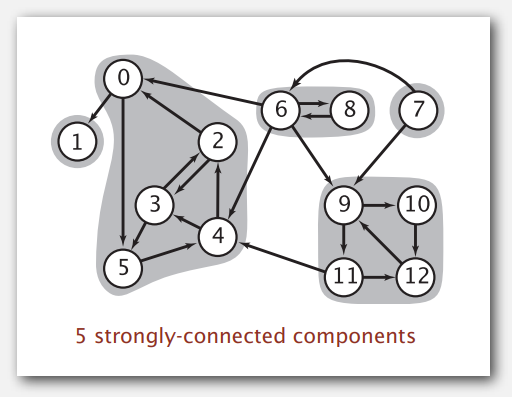
接下来我们来介绍 Kosaraju-Sharir 算法:其通过对 DAG id,属于同一个 strong components 的节点具有相同的 id。
- Phase 1: run DFS on
to compute reverse postorder. - Phase 2: run DFS on
, considering vertices in order given by first DFS.
Kernal DAG. Contract each strong component into a single vertex. (Tarjan 缩点)
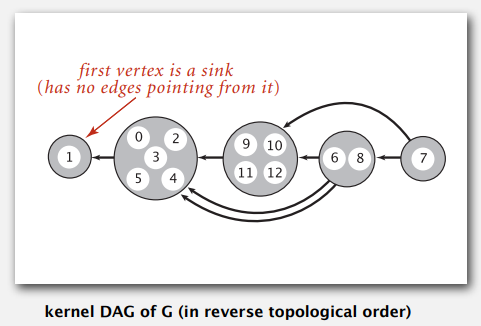
如图,按照逆拓扑序对 kernal DAG of
public class KosarajuSharirSCC {
    private boolean marked[];
    private int[] id;
    private int count;

    public KosarajuSharirSCC(Digraph G) {
        marked = new boolean[G.V()];
        id = new int[G.V()];
        DepthFirstOrder dfs = new DepthFirstOrder(G.reverse());
        for (int v : dfs.reversePost()) {
            if (!marked[v]) {
                dfs(G, v);
                count++;
            }
        }
    }
    private void dfs(Digraph G, int v) {
        marked[v] = true;
        id[v] = count;
        for (int w : G.adj(v))
            if (!marked[w])	dfs(G, w);
    }

    public boolean stronglyConnected(int v, int w) { return id[v] == id[w]; }
}