并查集
Union-Find
把并查集作为课程中第一个介绍的算法实在是独具匠心。
我现在还记得第一次学到并查集时的惊喜:它像是一篇精彩的短文,读完让人大呼过瘾。其实现是那么的精巧而简洁,以至于在之后在学习 BST,LCT 等复杂晦涩的算法时,我时常会怀念这种 Eureka 的感觉。
Problem Model: Dynamic Connectivity
Given a set of
- Union command: connect two objects.
- Find/connected query: is there a path connecting the two objects?
Primitive method: Given a unique
- Quick-Find:
updates the as an array. query by checking . - Quick-Union:
updates the as a forest. query by checking the of root.
Improvements
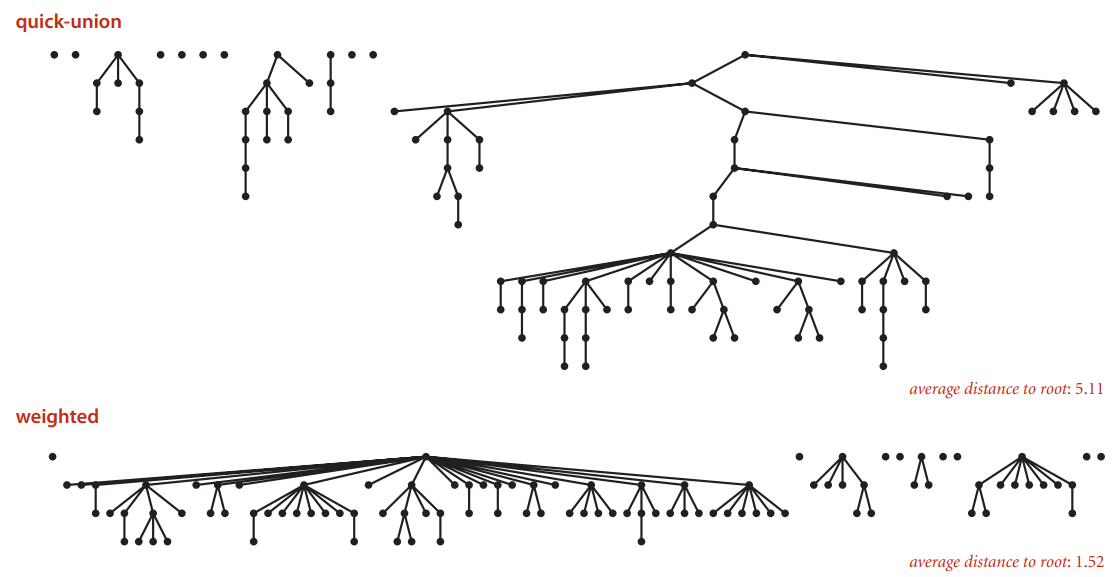
Improvement 1: Weighting
- Modify Quick-Union to avoid tall trees.
- Keep track of size of each tree (number of objects).
- Balance by linking the root of smaller tree to the root of larger tree. (Reasonable alternatives: union by height or "rank")
Proposition. Depth of any node
Pf. When does depth of
- The size of the tree containing
at least doubles since . - Size of tree containing
can double at most times.
Improvement 2: path compression
Just after computing the root of
Code Implementation
Weighted quick-union with path compression: in practice, WQUPC is linear.
java
public class UF {

    private int[] parent;	// parant[i] = parent of i
    private byte[] rank;	 // we apply union by rank here (never more than 31)
    private int count;       // numbers of connected components

    public UF(int n) {
        if (n < 0)	throw new IllegalArgumentException();
        count = n;
        parant = new int[n];
        rank = new byte[n];
        for (int i = 0; i < n; ++i) {
            parent[i] = i;
            rank[i] = 0;
        }
    }

    public int find(int p) {
        validate(p);
        while (p != parent[p]) {
            parent[p] = parent[parent[p]];	// path compression by halving
            p = parent[p];
        }
        return p;
    }

    public int count() {
        return count;
    }

    public boolean connected(int p, int q) {
        return find(p) == find(q);
    }

    public void union(int p, int q) {
        int rootP = find(p);
        int rootQ = find(q);
        if (rootP == rootQ)	return;

        if 	 (rank[rootP] < rank[rootQ])    parent[rootP] = rootQ;
        else if (rank[rootP] > rank[rootQ])	parent[rootQ] = rootP;
        else {
            parent[rootQ] = rootP;
            ++rank[rootP];
        }
        --count;
    }

    public void validate(int p) {
        int n = parent.length;
        if (p < 0 || p >= n) {
            throw new IllegalArgumentException("Index is not between 0 and " + (n-1));
        }
    }

    public static void main(String[] args) {
        int n = StdIn.readInt();
        UF uf = new UF(n);
        while (!StdIn.isEmpty()) {
            int p = StdIn.readInt();
            int q = StdIn.readInt();
            if (uf.find(p) == uf.find(q))	continue;
            uf.union(p, q);
            StdOut.println(p + " " + q);
        }
        StdOut.println(uf.count() + " components");
    }
}